Bladder Cancer Support Pack
R3174,00
- There is a lifetime 10% discount for products when testing is ordered, should you want to do this please contact us before purchasing online.
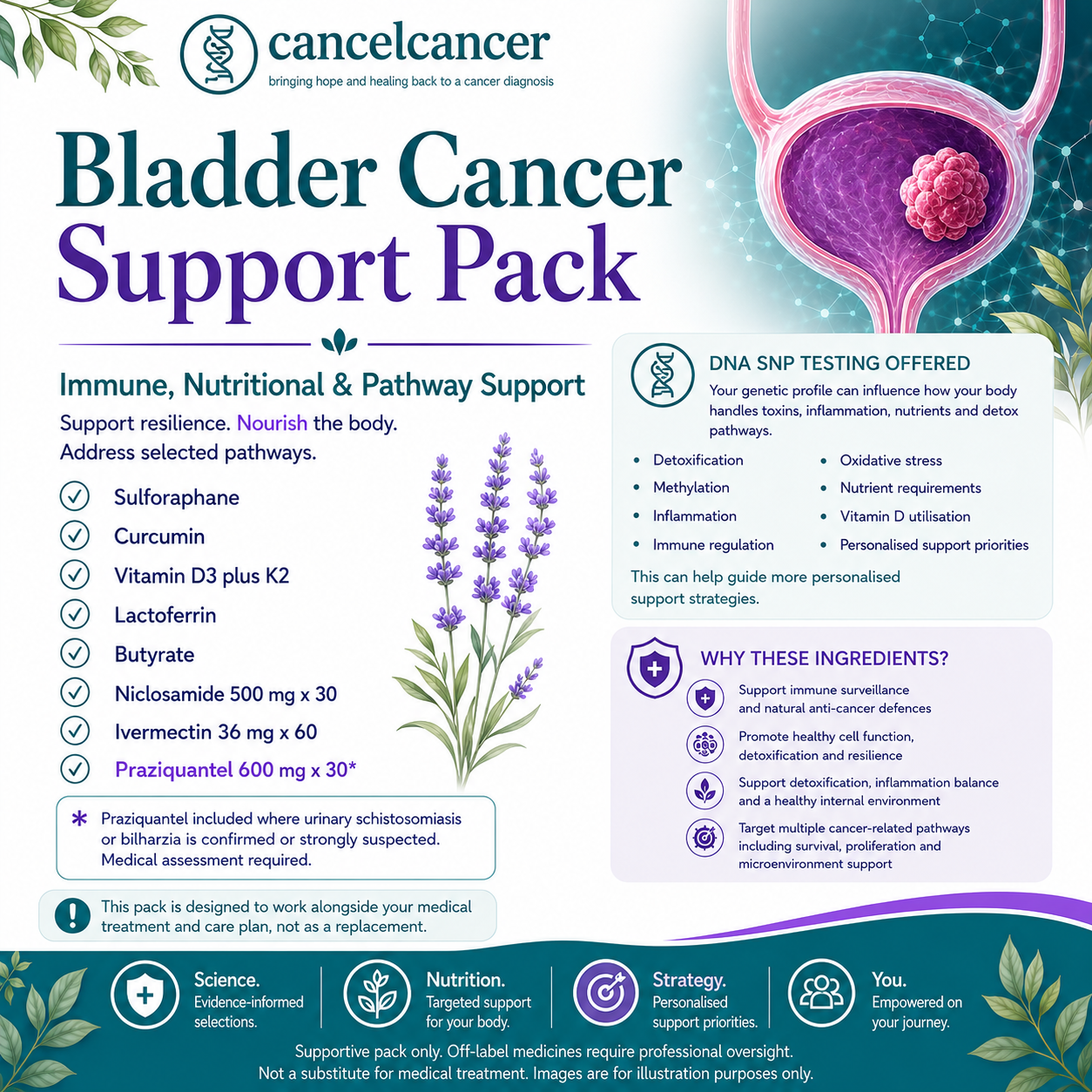
The Bladder Cancer Support Pack combines carefully selected nutritional products with research-informed pathway support. It is designed to support urinary health, the intestinal and mucosal environment, nutritional resilience and selected cellular pathways alongside the patient’s existing urology and oncology care.
What Is Included in the Bladder Cancer Support Pack?
- Sulforaphane
- Curcumin
- Vitamin D3 plus K2
- Lactoferrin
- Butyrate
- Niclosamide 500 mg × 30
- Ivermectin 36 mg × 60
- Praziquantel 600 mg × 30*
Protect. Nourish. Support the journey.
Why These Ingredients Were Selected
Sulforaphane
Sulforaphane is one of the most relevant nutritional compounds investigated in bladder-cancer research. Its metabolites are excreted through the urinary tract, creating direct exposure within the bladder. Laboratory and animal research has reported effects on bladder-cancer growth, treatment-resistant cells, glycolytic metabolism, invasion and metastatic behaviour. These findings remain preclinical but make sulforaphane a particularly relevant component of the Bladder Cancer Support Pack.
Curcumin
Curcumin is included for its broad anti-inflammatory and cellular-pathway support. In bladder-cancer cell and animal models, curcumin has been investigated for effects on cell-cycle control, apoptosis and tumour development. Human clinical benefit has not yet been established.
Vitamin D3 Plus K2
Vitamin D supports immune regulation, bone health and normal cellular communication. Low vitamin D status has repeatedly been associated with a higher risk of bladder cancer, although supplementation has not been proven to treat an existing tumour. Vitamin D requirements should therefore be guided by blood testing rather than assumed.
Lactoferrin and Butyrate
Lactoferrin and butyrate provide supportive care for the intestinal lining, mucosal health and the wider gut–immune environment. They are included as nutritional and terrain-support products rather than direct treatments for bladder cancer.
Niclosamide
Niclosamide is a repurposed medicine being investigated across several cancer-related pathways. Bladder and urothelial cancer laboratory models have reported reduced cell viability, colony formation and increased apoptosis following niclosamide exposure. Its role in patients remains experimental, and ordinary oral niclosamide has important absorption limitations.
Ivermectin
Ivermectin has demonstrated bladder-cancer-specific activity in laboratory and animal research, including inhibition of tumour-cell growth and induction of oxidative stress, DNA damage and apoptosis. This does not yet establish ivermectin as a proven bladder-cancer treatment.
Praziquantel and Bilharzia
Praziquantel is included only where urinary schistosomiasis, also known as bilharzia, is confirmed or strongly suspected.
Chronic urogenital schistosomiasis can cause inflammation, fibrosis and damage to the bladder and is associated with an increased risk of bladder cancer. Praziquantel is the World Health Organization’s recommended medicine for treating schistosomiasis. It is included to address the parasitic infection where relevant—not as a direct treatment for an established bladder tumour.
Focused Urinary, Nutritional and Pathway Support
The Bladder Cancer Support Pack brings the selected products together in one organised combination. The pack is intended to simplify access to supportive products while maintaining the need for individual medical assessment, interaction screening and professional oversight.
Important safety notice: This is a supportive, research-informed pack and is not a replacement for cystoscopy, surgery, intravesical treatment, chemotherapy, radiotherapy, immunotherapy or other urology and oncology care. Niclosamide and ivermectin are experimental in this context. Praziquantel requires an appropriate assessment for schistosomiasis. Kidney and liver function, blood results, current treatment and medicine interactions must be reviewed. Images are for illustration purposes only.